
Trying to stand out in the crowded Toronto market can feel like an uphill battle for any small or medium-sized business owner. Without clear goals guiding your content marketing, valuable time and resources often get lost without delivering real results. When you set actionable goals, you unlock a practical framework that clarifies your message and helps you actually measure success. This guide reveals step-by-step strategies to strengthen your content marketing, ensuring your efforts connect with the right audience and support real business growth.
Table of Contents
- Step 1: Define Clear Content Marketing Goals
- Step 2: Identify and Research Your Ideal Audience
- Step 3: Develop Engaging Content Strategies
- Step 4: Create and Optimize Valuable Content
- Step 5: Promote Content Across Key Channels
- Step 6: Measure Success and Refine Campaigns
Quick Summary
| Key Point | Explanation |
|---|---|
| 1. Define specific content goals | Set clear, measurable goals aligned with business objectives to guide your content marketing efforts effectively. |
| 2. Understand your target audience | Conduct comprehensive research to create audience personas and tailor content that resonates with potential customers. |
| 3. Create engaging content strategies | Develop varied content formats and storytelling approaches to foster deeper connections and keep your audience interested. |
| 4. Optimize content for visibility | Utilize keyword research and multimedia elements to enhance readability and discoverability, making your content more valuable. |
| 5. Measure and refine your strategy | Regularly evaluate content performance metrics to inform future decisions, ensuring strategies evolve with audience needs. |
Step 1: Define Clear Content Marketing Goals
Defining clear content marketing goals is the foundational strategy that transforms random content creation into a systematic approach for business growth. By establishing precise objectives, you create a roadmap that aligns your digital content with your broader business outcomes.
To set effective content marketing goals, you need a strategic framework that connects your content efforts directly to measurable business results. Comprehensive goal setting strategies indicate that well-defined objectives can boost marketing outcomes by up to 40%. Here are key steps to establish powerful content marketing goals:
- Identify specific business objectives such as brand awareness, lead generation, or sales conversion
- Define quantifiable key performance indicators (KPIs)
- Align content goals with overall marketing and business strategies
- Create measurable targets for engagement, traffic, and conversions
Successful goal setting requires understanding your target audience’s needs and behaviors. By crafting goals that resonate with your audience’s interests, you can create content that genuinely connects and drives action. Strategic content planning emphasizes the importance of knowing your audience deeply and developing targeted content missions.
Here’s a summary of content marketing goals and their business impact:
| Goal Type | Typical KPI | Direct Business Impact |
|---|---|---|
| Brand Awareness | Impressions, reach | Increases brand recognition |
| Lead Generation | Leads, signup rate | Expands potential customer base |
| Sales Conversion | Conversion rate, revenue | Boosts actual sales |
| Customer Engagement | Comments, shares, time | Improves loyalty and retention |
Content marketing goals are not just objectives—they are your strategic compass for digital growth.
Pro tip: Conduct quarterly reviews of your content marketing goals to ensure continuous alignment with evolving business needs and market dynamics.
Step 2: Identify and Research Your Ideal Audience
Understanding your target audience is the critical foundation of successful content marketing. This step transforms generic content strategies into precision-targeted communication that resonates deeply with your potential customers.
Comprehensive audience research techniques involve diving beyond surface-level demographics to uncover the nuanced preferences and behaviors of your potential customers. Effective audience identification requires a multifaceted approach:
- Conduct demographic analysis including age, location, income, and profession
- Perform psychographic segmentation to understand values, interests, and lifestyle
- Use behavioral data to track online interactions and content consumption patterns
- Develop detailed audience personas representing your ideal customer segments
Successful audience research goes beyond basic data collection. Strategic audience targeting requires an empathetic approach that considers the deeper motivations and challenges of your potential customers. This means looking beyond numbers to understand the emotional and practical needs driving their decisions.
Your audience is not just a demographic—they are real people with complex needs and aspirations.
Pro tip: Continuously update your audience research by regularly collecting feedback through surveys, social media interactions, and direct customer conversations.
Step 3: Develop Engaging Content Strategies
Crafting an engaging content strategy is the secret weapon that transforms ordinary marketing efforts into compelling audience experiences. This step is about creating a blueprint that not only captures attention but also drives meaningful connections with your target audience.
Innovative content design techniques reveal multiple approaches to keep your audience thoroughly engaged. Your content strategy should incorporate diverse elements that speak directly to your audience’s preferences:
- Develop multimedia content including videos, podcasts, and interactive elements
- Create storytelling frameworks that connect emotionally with your audience
- Design interactive content such as quizzes, calculators, and assessment tools
- Implement personalization strategies that make each content piece feel tailored
Digital content strategy evolution demonstrates the importance of understanding deeper meaning-making processes. Modern content strategies must go beyond surface-level information, diving into the cultural and emotional contexts that truly resonate with your audience. This means creating content that doesn’t just inform but genuinely connects and provides value.
Engaging content is not about speaking to an audience—it’s about starting a meaningful conversation.
Pro tip: Regularly audit your content performance and be willing to pivot your strategy based on audience feedback and engagement metrics.
Step 4: Create and Optimize Valuable Content
Creating valuable content is the cornerstone of successful content marketing that transforms casual readers into engaged customers. This step focuses on developing high-quality, purposeful content that resonates deeply with your target audience and drives meaningful business outcomes.
AI-enhanced content creation strategies offer powerful tools to elevate your content development process. Your content optimization approach should incorporate these key elements:
- Conduct thorough keyword research to align content with audience search intent
- Develop comprehensive, original content that provides genuine value
- Structure content for readability with clear headings, bullet points, and concise paragraphs
- Incorporate multimedia elements like images, infographics, and videos
Human-AI collaborative writing techniques demonstrate the potential of blending technological efficiency with human creativity. Successful content optimization requires a strategic approach that balances technological tools with authentic, high-quality writing. This means using AI as an assistant, not a replacement, to enhance your content’s depth, clarity, and impact.

Review how AI and human collaboration enhance content creation:
| Approach | Strengths | Limitations | Best Use Case |
|---|---|---|---|
| Human-Created Content | Creativity, authenticity | Time-consuming | Brand storytelling, opinion pieces |
| AI-Enhanced Content | Speed, data analysis | Lacks personality | SEO, bulk info guides |
| Human-AI Collaboration | Quality, scalability | Requires skilled oversight | Research-driven, expert articles |
Valuable content is not about quantity—it’s about creating meaningful connections that solve real problems.
Pro tip: Implement a rigorous content review process that includes peer feedback, fact-checking, and alignment with your brand’s core messaging and audience needs.
Step 5: Promote Content Across Key Channels
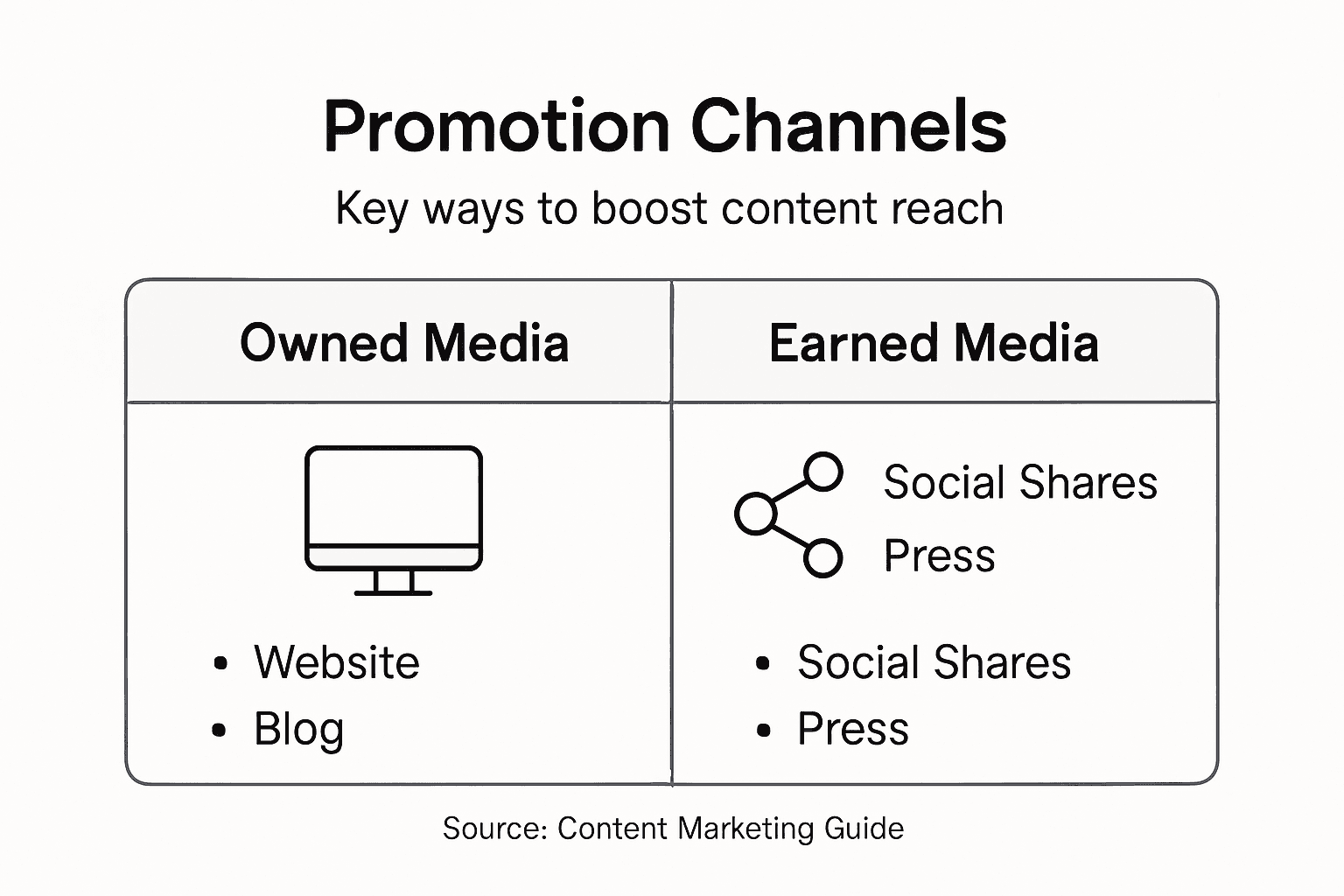
Successful content promotion is about strategically amplifying your message across multiple platforms to maximize reach and engagement. This step transforms your carefully crafted content into a powerful tool for connecting with your target audience and driving meaningful interactions.
Strategic content promotion techniques require a systematic approach that goes beyond simple sharing. Your content distribution strategy should encompass these critical channels:
- Leverage social media platforms with platform-specific content adaptations
- Create email marketing campaigns targeting segmented audience groups
- Utilize industry-specific online communities and professional networks
- Develop cross-channel promotional calendars for consistent messaging
Social media content dissemination strategies emphasize the importance of crafting engaging, interactive content that resonates with each platform’s unique audience. This means tailoring your message, using compelling visuals, and creating platform-specific hooks that encourage sharing and interaction.
Effective content promotion is an art of storytelling across multiple digital landscapes.
Pro tip: Implement a cross-platform tracking system to measure engagement metrics and continuously refine your promotion strategy based on real-time performance data.
Step 6: Measure Success and Refine Campaigns
Measuring the performance of your content marketing efforts is crucial for continuous improvement and strategic growth. This step transforms raw data into actionable insights that will help you optimize your marketing strategies and maximize your return on investment.
Digital marketing ROI analysis requires a comprehensive approach to tracking key performance indicators. Your measurement strategy should focus on these critical metrics:
- Calculate customer acquisition costs
- Track conversion rates across different content channels
- Analyze customer lifetime value
- Monitor engagement metrics like time on page and social shares
- Evaluate return on investment (ROI) for each content piece
Systematic campaign evaluation techniques emphasize the importance of continuous learning and adaptation. By systematically collecting and analyzing data, you can identify successful tactics, understand audience preferences, and make informed decisions that drive your content marketing strategy forward.
Data is the compass that guides your content marketing journey toward meaningful growth.
Pro tip: Implement a quarterly review process where you comprehensively analyze your content performance metrics and develop targeted improvement strategies based on your findings.
Take Your Content Marketing Goals to the Next Level with Expert Support
If you find defining clear content marketing goals, identifying your ideal audience, or creating engaging strategies challenging, you are not alone. Many business owners struggle to translate these important steps into measurable growth. At Click Typhoon, we specialize in helping local businesses overcome those exact pain points by delivering tailored SEO and content marketing solutions that drive real results. From data-driven keyword research to high-quality content creation and strategic promotion across multiple channels, we ensure your content connects deeply with your audience and generates measurable ROI.
Ready to transform your content marketing efforts and boost business growth fast Visit Click Typhoon today to explore our comprehensive digital marketing services. Discover how our systematic audits, technical SEO expertise, and personalized social media marketing plans can help you hit your content goals faster. Don’t wait – start turning your content strategy into lasting business success now by partnering with Click Typhoon for professional guidance tailored to your unique needs.
Frequently Asked Questions
How can I define clear content marketing goals to boost business growth?
Defining clear content marketing goals involves identifying specific business objectives like brand awareness or lead generation. Start by establishing measurable targets for engagement and conversions, ensuring they align with your overall business strategy.
What steps should I take to identify and research my ideal audience?
To identify and research your ideal audience, conduct demographic analysis on factors like age and location, and perform psychographic segmentation to understand their values and interests. Develop detailed audience personas that represent your target customer segments to guide your content creation.
How do I develop engaging content strategies that resonate with my audience?
Developing engaging content strategies starts with creating multimedia content and implementing storytelling frameworks that connect emotionally with your audience. Test various formats, such as quizzes or videos, and gather feedback to refine your approach based on audience preferences.
What are the best practices for measuring content marketing success?
Measuring content marketing success involves tracking key performance indicators like conversion rates and customer acquisition costs. Regularly analyze engagement metrics and evaluate the return on investment for each content piece to inform future strategies, adjusting accordingly for continual improvement.
How can I optimize my content for better visibility and engagement?
To optimize your content, conduct thorough keyword research to align with audience search intent and ensure your writing is structured for readability. Incorporate multimedia elements like images and videos, as these can significantly boost engagement rates and overall content effectiveness.
What channels should I use to promote my content effectively?
Promote your content across various channels, including social media and targeted email campaigns. Tailor your messaging for each platform, using compelling visuals and interactive elements to enhance engagement and maximize reach.