How Long Does Law Firm SEO Take to Show Results?
Law firms often begin SEO with one urgent question: How long will it take before this investment produces results?
It is a reasonable question. Legal marketing can be expensive, and firm leaders need to know whether the work is moving in the right direction. The challenge is that SEO does not produce one type of result on one predictable date.
Technical fixes may improve crawling within weeks. Search impressions may rise before website traffic does. Some pages may move higher in search results while others take longer. Qualified inquiries may increase only after the website gains enough visibility, trust, and useful content to reach the right people.
A new website in a highly competitive city may need more time than an established firm with strong local authority. Results also depend on implementation speed, competition, content quality, technical condition, links, reputation, and the firm’s definition of success.
Understanding these variables makes it easier to set a realistic law firm SEO timeline without expecting overnight rankings.
How Long Does Law Firm SEO Take?
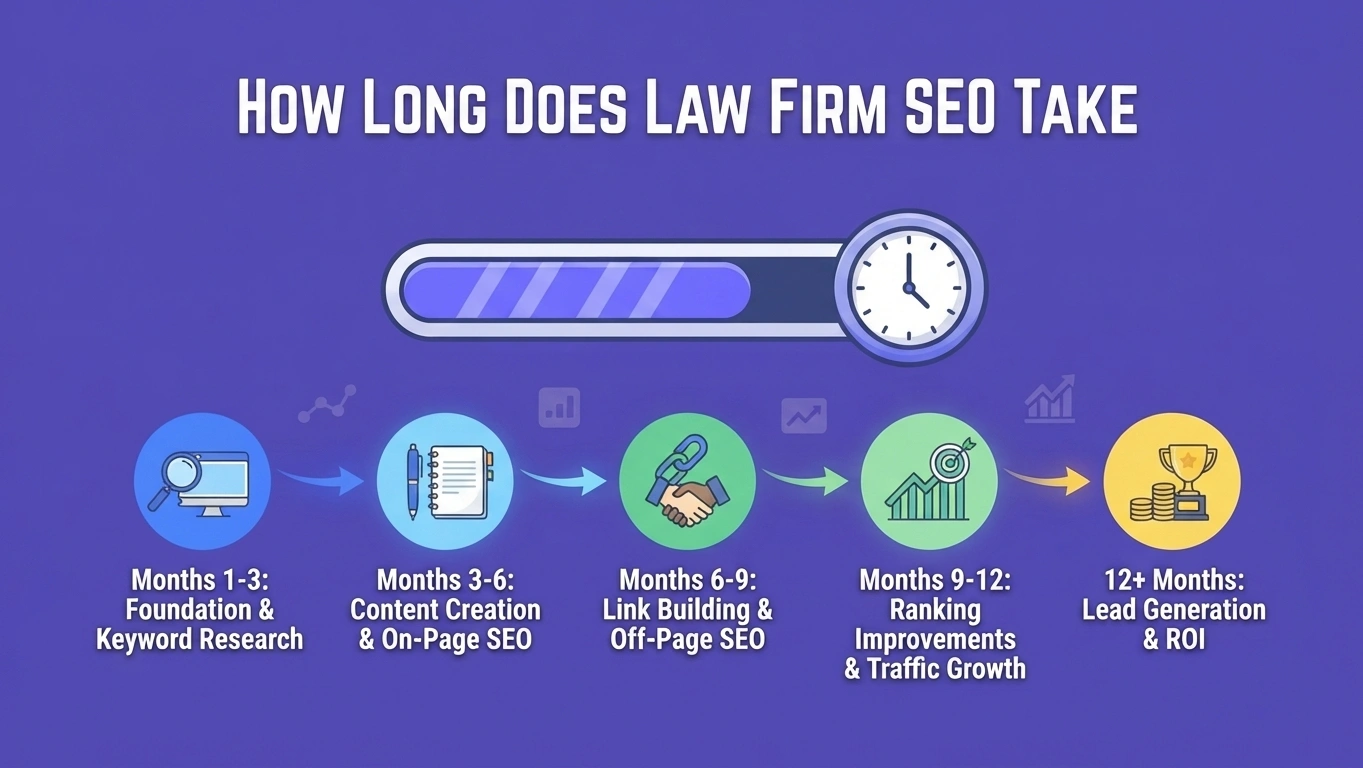
A firm may begin seeing early indicators within the first three months, such as improved indexing, more search impressions, or movement for less competitive terms. More noticeable gains in organic traffic and qualified inquiries often require six to twelve months of consistent work, especially in competitive legal markets.
These ranges are planning estimates, not guarantees. An established firm with a healthy website may improve sooner, while a new domain, competitive market, site migration, or history of poor SEO can extend the timeline.
The type of result also matters. Fixing technical errors is different from ranking for a valuable search term, and higher traffic is different from signing more suitable clients.
SEO should therefore be measured through progressive milestones, including technical health, indexed pages, relevant impressions, organic clicks, qualified inquiries, consultations, and retained clients.
A responsible provider should explain what is being measured, what has changed, and why the strategy may need adjustment rather than promising a specific ranking by a specific date.
What Counts as an SEO Result for a Law Firm?
The word “results” can mean different things. If a firm expects signed cases while its SEO provider reports only impressions, both sides may be discussing completely different outcomes.
Early SEO results may include resolved technical errors, improved indexing, and more appearances in search results. These changes indicate that Google can find and understand more of the website, but they do not necessarily create immediate traffic.
The next stage may involve ranking improvements, additional organic clicks, and more visitors reaching important service pages. Business results come later and may include qualified calls, consultation requests, retained clients, and suitable cases attributed to organic search.
An SEO strategy for personal injury lawyers should track this complete path. Rankings are useful indicators, but they are not the final business goal. A page may rank well for a low-value term while another page with less traffic attracts people with much stronger legal intent.
A Realistic Law Firm SEO Timeline
The following timeline shows how a campaign may develop. It is an illustrative planning framework rather than a promise.
| Time period | Common areas of focus | Possible indicators |
| Month 1 | Audit, analytics setup, research, technical review, competitor analysis | Baseline established and priority problems identified |
| Months 2 to 3 | Technical fixes, page revisions, local optimization, initial content | Better crawling, indexing, and early impression growth |
| Months 3 to 6 | Practice-area content, internal links, local pages, authority development | Broader keyword visibility, ranking movement, and early traffic gains |
| Months 6 to 12 | Continued publishing, page refinement, local authority, conversion work | More consistent traffic and potential growth in qualified inquiries |
| Beyond 12 months | Expansion, testing, updating, and competitive defense | Broader coverage, compounding visibility, and stronger performance data |
Actual progress will not always follow this sequence. Some technical changes may show effects quickly, while highly competitive service pages may require much longer.
Seasonality, search-system changes, competitor activity, and case demand can also affect performance. SEO should therefore be evaluated over meaningful periods rather than through short-term fluctuations.
Why Can Law Firm SEO Take Longer Than SEO in Other Industries?
Legal searches are highly competitive because a single qualified case may have significant value. Many firms invest heavily in content, advertising, links, websites, and local visibility.
Established competitors may also have years of accumulated authority, including strong local recognition, extensive practice-area content, reputable links, and large review profiles.
Legal content requires additional care as well. Pages discussing liability, compensation, deadlines, and legal procedures need to be accurate and appropriate for the relevant jurisdiction. Publishing quickly offers little value if the information is generic, repetitive, or misleading.
Personal injury competition can be particularly intense in major cities. Instead of relying only on broad phrases, a campaign may need to target local searches, specific case types, informational questions, and branded visibility.
How Does the Website’s Starting Point Affect the Timeline?
SEO does not begin from the same starting point for every law firm. An established domain with useful content, clean technical foundations, and credible links may respond differently from a newly launched website.
A site with serious technical problems may need substantial repair before its content can perform. Common issues include pages blocked from search engines, broken links, duplicate content, poor mobile usability, incorrect redirects, and confusing site structure.
Previous SEO work can also affect progress. If a firm purchased low-quality links, generated hundreds of thin pages, or changed URLs without proper redirects, those issues may need to be corrected first.
Website redesigns and migrations add another variable. A properly planned migration can preserve visibility, while mistakes may cause traffic losses that take time to diagnose.
The initial audit should establish the website’s condition, opportunities, risks, and priorities. Without that baseline, timeline estimates are largely guesswork.
How Does Competition Affect SEO Results?
Competition varies by practice area and location. Ranking for a specific service in a smaller market may be more achievable than ranking for a broad personal injury phrase in a major city.
Competitor strength matters as much as the number of competitors. A market may contain only a few prominent firms, but those businesses may have strong brands, developed websites, local offices, active content strategies, and authoritative links.
Search intent also affects difficulty. A broad phrase such as “personal injury lawyer” may face intense competition, while a detailed question about a specific accident type may offer a more focused opportunity.
Keyword tools can help estimate relative difficulty, but they do not have access to Google’s internal ranking data and cannot guarantee results. Competitive analysis should also consider page quality, local relevance, authority, and the resources required to create something more useful.
Does Publishing More Content Make SEO Work Faster?
Publishing useful content can expand the number of searches for which a law firm may appear, but volume alone does not make SEO work faster.
A strong content strategy may include practice-area pages, location pages, FAQs, attorney biographies, and educational articles. Each page should serve a clear purpose and provide accurate, understandable information.
Publishing dozens of nearly identical city or service pages may create little value and make the website harder to maintain.
For personal injury firms, content can address both immediate service searches and earlier informational questions. Someone researching what to do after a collision may later need an attorney, and useful information can introduce the firm before that person is ready to call.
Content also needs time to be discovered, evaluated, and supported through internal links and broader authority.
How Do Technical SEO Problems Delay Results?
Technical SEO helps search engines access, interpret, and organize website content. If important pages cannot be crawled or indexed, strong writing may remain invisible.
Broken internal links can isolate useful pages. Duplicate versions may divide signals. Incorrect canonical tags or redirects can point search engines toward the wrong URLs. Poor mobile performance may also frustrate visitors before they reach important information.
Fixing these issues does not automatically produce high rankings. Technical work removes barriers and creates a stronger foundation for content, authority, and local optimization.
Some fixes can be completed quickly, but Google still needs time to revisit pages and process changes. Large websites and complex migrations may require more time than smaller sites.
How Does Local SEO Affect the Timeline?
Local SEO helps a firm appear for searches connected to a geographic area. It may involve Google Business Profile optimization, consistent business information, local pages, reviews, links, and community relevance.
Local and traditional organic results do not always improve at the same speed. A firm might gain visibility in standard search results while remaining limited in map results because distance is an important local factor.
The accuracy and eligibility of the office also matter. Virtual offices and duplicate profiles may create policy problems, while new profiles may require verification.
Reviews and local authority develop gradually. A sustainable approach asks clients for honest feedback without incentives and builds community recognition through genuine relationships.
Why Do Links, Mentions, and Reputation Take Time?
Links from reputable websites can help search engines discover content and understand a firm’s authority. However, valuable links are rarely created in bulk overnight.
A law firm may earn relevant mentions through community involvement, legal education, professional relationships, original resources, events, or legitimate media coverage.
Buying large link packages or participating in link schemes may create risk. Sustainable authority building focuses on relevance and credibility rather than raw link counts.
Brand reputation also matters. Potential clients may search for the firm by name, read reviews, compare attorney profiles, and look for signs that the business is legitimate. Search visibility and reputation often grow together.
Can Paid Ads Make Law Firm SEO Work Faster?
Paid advertising can place a firm in search results quickly, but it does not directly improve organic rankings. Google states that advertising does not affect a website’s position in organic search.
Ads can still support the broader marketing strategy. Firms can use paid campaigns to test search terms, messages, locations, and landing pages while organic visibility develops.
Paid traffic may also provide useful conversion data. If a particular service and message consistently attract qualified prospects, those findings can inform organic pages.
The channels should remain separate in reporting. Paid clicks stop when the budget stops, while SEO aims to build visibility without a charge for each organic click.
How Should a Law Firm Measure SEO Progress?
Google Search Console is one of the most useful sources for organic search data. Its Performance report shows impressions, clicks, click-through rate, average position, search queries, pages, countries, and devices.
Impressions may increase before clicks because a page can begin appearing in lower positions before moving higher.
Reports should compare meaningful periods, such as the most recent three or six months against the previous equivalent period. Weekly fluctuations may result from seasonality, weekends, news events, or changes in demand.
Website analytics, call tracking, forms, and intake systems can then connect search traffic with business outcomes. Firms should distinguish branded searches from non-branded discovery and separate general inquiries from qualified cases.
Any tracking setup should also protect confidential and sensitive information.
Signs That a Law Firm SEO Campaign Is Moving Forward
Positive indicators may include:
- More relevant pages appearing in search results
- Growth in non-branded impressions
- Ranking improvements across useful searches
- Higher organic traffic to service and location pages
- Increased Google Business Profile activity
- More qualified calls and consultation requests from organic search
- Better conversion performance on important landing pages
- Growth that continues over several months rather than one short spike
Not every indicator will improve at the same time. A campaign should be evaluated as a connected system rather than through one keyword or metric.
Why Do SEO Results Sometimes Stall?
SEO growth rarely follows a straight line. A campaign may plateau because competitors improved, implementation slowed, content stopped expanding, technical problems returned, or search demand changed.
A website can also attract more traffic without generating more inquiries. In that case, the problem may involve search intent, page messaging, trust signals, contact options, or intake rather than visibility itself.
Major redesigns, content removal, URL changes, lost links, and Google search-system updates may also affect performance.
A plateau should lead to diagnosis rather than random changes. Firms should review queries, pages, conversions, technical health, competitors, and implementation history before deciding what to adjust.
What Are the Red Flags Behind Fast SEO Promises?
Google’s official guidance warns that no one can guarantee a number-one ranking. Its page on choosing an SEO provider also recommends asking how results will be measured and avoiding providers that are secretive about their methods.
Be cautious when an agency promises page-one rankings within a fixed number of days, claims to have a special relationship with Google, or refuses to explain its work.
Other warning signs include unexplained link packages, thousands of automatically generated pages, vague reports, and a focus on traffic without any connection to qualified inquiries.
A responsible provider should set realistic expectations, describe the planned work, document changes, and explain how the strategy relates to the firm’s services and market.
How Can a Law Firm Improve Its Chances of Seeing Results Sooner?
A firm cannot control Google or its competitors, but it can reduce unnecessary delays.
Prompt approval of technical work and content keeps implementation moving. Attorneys can provide accurate service information, clarify jurisdictional details, and review legal claims efficiently.
The firm should also prioritize valuable and realistic opportunities rather than trying to rank for every legal phrase immediately. Technical repairs, core service pages, local accuracy, and conversion tracking may deserve attention before a large blog expansion.
A strong intake process is equally important. Better visibility cannot create business value if calls go unanswered or form submissions receive no response.
Consistent work gives SEO the best opportunity to compound. Frequent pauses or changing strategies every month can make performance harder to evaluate.
Why Choose Click Typhoon for Law Firm SEO?
Click Typhoon approaches law firm SEO as a coordinated process involving technical performance, content, local visibility, conversion planning, and measurement.
The strategy should begin with the firm’s actual position. A new practice in a competitive city needs a different plan from an established regional firm with years of search visibility.
Click Typhoon focuses on transparent reporting and practical milestones rather than guaranteed rankings or artificial deadlines. This helps firms understand what has been completed, which indicators are improving, and where the strategy may need adjustment.
No responsible SEO provider can promise a specific result by a specific date. Search performance depends on the website, market, competition, resources, implementation, and many other factors.
Frequently Asked Questions
Can law firm SEO produce results in three months?
Early results may appear within three months, including better indexing, more impressions, or movement for less competitive searches. Significant traffic and qualified-lead growth may require more time.
How often should a law firm publish new content?
There is no universal schedule. The firm should publish at a pace that allows it to create accurate, useful, and distinctive content while maintaining existing pages.
Does a new law firm website take longer to rank?
Often, yes. A new website may need time to be discovered, indexed, trusted, and supported by content, local signals, links, and reputation. The exact timeline varies.
Can paid ads improve organic rankings?
No. Paying for Google Ads does not directly improve organic rankings. Ads can provide immediate visibility and useful conversion data while SEO develops.
How can a law firm tell whether SEO is working?
The firm should track technical health, indexing, impressions, rankings, clicks, qualified inquiries, consultations, and retained clients. Progress should be assessed over meaningful time periods.
Should a law firm stop SEO after reaching page one?
Stopping completely can allow content to become outdated and competitors to gain ground. Maintenance, measurement, and strategic improvement remain important even after strong visibility develops.
Build SEO Around Realistic Milestones
Law firm SEO rarely produces instant results, but progress can be measured before final business outcomes appear. Technical improvements, indexing, impressions, rankings, traffic, and qualified leads form a sequence that helps firms evaluate whether a campaign is developing.
If your firm wants a realistic assessment based on its website, competition, and market, explore Click Typhoon’s Personal Injury Lawyer SEO services and request a consultation.
Follow us on our socials here:
Check out some of our blogs to help with your SEO needs: