How to Market a Personal Injury Law Firm Without Wasting Ad Spend
Personal injury advertising can become expensive quickly. A campaign may generate clicks and phone calls while producing few cases that match the firm’s services. Increasing the budget will not solve that problem if the targeting, tracking, landing pages, or intake process is weak.
Wasted ad spend is not limited to irrelevant clicks. Money is also wasted when the firm sends visitors to confusing pages, misses calls, responds slowly, or counts every inquiry as a successful conversion.
An effective personal injury law firm advertising strategy begins by defining the cases the firm wants. Campaigns can then target the right practice areas, locations, and search intentions. Accurate conversion tracking and intake feedback reveal which channels are producing appropriate opportunities.
The objective is not always to spend less. It is to invest more carefully and understand what happens between the initial click and a signed case.
How Do You Market a Personal Injury Law Firm Without Wasting Ad Spend?
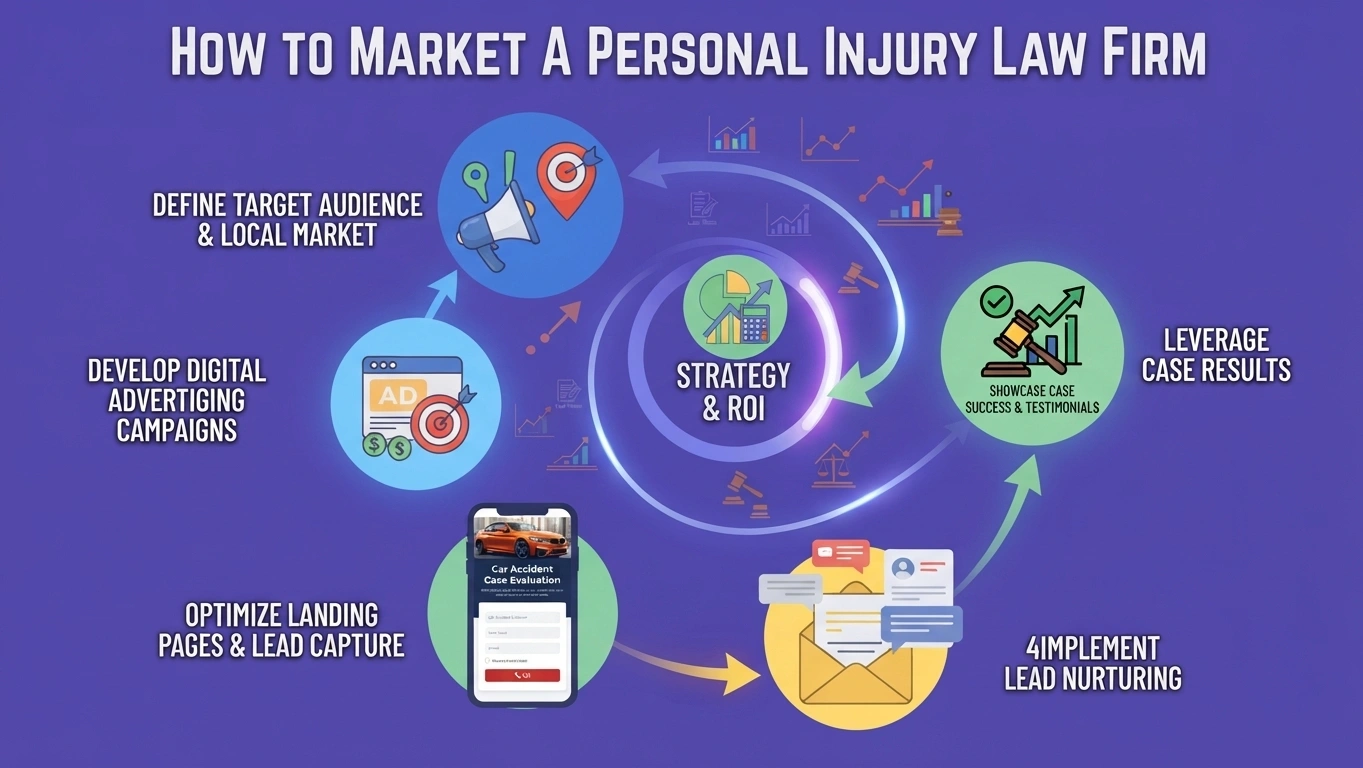
To market a personal injury law firm without wasting ad spend, begin by defining the cases, locations, and prospective clients the firm wants to reach.
Separate campaigns by practice area and search intent so budgets can be evaluated accurately. Use geographic controls and negative keywords to reduce irrelevant clicks. Send each advertisement to a focused landing page that explains the appropriate service and provides clear contact options.
Track calls and forms, but do not treat every inquiry as a qualified lead. Intake staff should record whether each contact becomes a qualified opportunity, consultation, or signed case. This information should guide keyword, budget, and campaign decisions.
SEO for personal injury lawyers can complement advertising by building longer-term organic visibility and reducing dependence on paid clicks.
Every marketing claim should remain truthful and comply with applicable attorney advertising requirements. No campaign can guarantee cases, but careful targeting and measurement can make the budget more accountable.
Define a Qualified Lead Before Spending Money
A law firm should know what it considers a qualified lead before launching or expanding an advertising campaign.
Qualification may depend on the practice area, accident location, jurisdiction, injury, timing, potential liability, and whether the firm has the resources to evaluate the matter. The exact criteria will vary by firm.
An inquiry is not automatically a qualified lead. A qualified lead is not automatically a consultation, and a consultation is not automatically a signed case. These stages should be recorded separately.
If an advertising platform is told that every phone call is a successful conversion, it may optimize toward calls that have little business value. Clear qualification criteria allow the firm to identify which keywords, advertisements, locations, and landing pages are producing appropriate opportunities.
Understand the Economics of Different Case Types
Different personal injury cases can have different acquisition costs, acceptance standards, staffing requirements, and timelines. A single target cost per lead may not make sense across every campaign.
The firm should estimate how many inquiries typically become qualified leads, how many qualified leads become consultations, and how many consultations become signed cases. These rates can help establish a reasonable acquisition target.
Any calculation should remain conservative. A large past settlement does not establish the predictable value of future cases. Results depend on liability, insurance, damages, evidence, jurisdiction, and many other factors.
The purpose of understanding case economics is not to promise a return. It is to determine whether the firm is spending more to acquire cases than its broader business model can reasonably support.
Fix Conversion Tracking Before Raising the Budget
Campaign performance cannot be evaluated accurately when tracking is incomplete.
The firm should track calls, forms, chats, scheduled consultations, and signed cases where practical. Each conversion should have a clear definition. A short phone call about an unrelated legal issue should not carry the same value as a scheduled consultation involving a target case.
Google Ads guidance on measuring calls explains that advertisers can track calls from advertisements and website visits. Google also allows advertisers to create call-conversion criteria and import later outcomes.
Automated tracking still requires human review. A long call may be irrelevant, while a shorter call may be valuable. Intake and case-management information should be connected with campaign data when privacy, consent, confidentiality, and applicable laws permit.
Call recording requirements vary, so firms should obtain appropriate legal guidance before recording or analyzing calls.
Separate Campaigns by Practice Area and Intent
Placing every injury-related keyword into one campaign makes it difficult to control budgets or understand performance.
Car accidents, commercial truck collisions, premises liability, and wrongful death matters may involve different searches and qualification criteria. Separate campaigns or tightly organized ad groups allow each service to use appropriate keywords, advertisements, landing pages, and budgets.
Search intent also matters. Someone looking for the definition of a legal term may not be ready to contact an attorney, while a person searching for a lawyer in a specific city may show stronger commercial intent.
Informational searches are not always worthless, but firms should understand when they are paying for research traffic. Paid campaigns can prioritize searches closer to consultation, while SEO and educational content address earlier questions through organic visibility.
Tighten Geographic Targeting
Advertising outside a legitimate service area can consume a large portion of the budget.
Campaigns should focus on locations where the firm can provide services and where target cases are likely to fall within an appropriate jurisdiction. Settings should be reviewed carefully because some platforms may reach people who show interest in a location even when they are not physically there.
Search-term and location reports can reveal unexpected traffic. Irrelevant cities, states, or countries should be excluded when appropriate.
Landing pages and advertisements should also accurately describe the firm’s presence. A law firm should not imply that it has an office in a location where no legitimate office exists. Geographic relevance should reflect actual capabilities rather than an attempt to appear everywhere.
Use Negative Keywords and Review Search Terms
Negative keywords prevent advertisements from appearing for selected irrelevant searches.
A personal injury campaign may attract searches related to law school, attorney jobs, free document templates, unrelated legal services, or general research. Some of these may be excluded after the firm confirms they do not support its goals.
Search terms should be reviewed regularly because keyword-matching systems can connect advertisements with queries the firm did not anticipate. This process can identify both wasted clicks and useful new keywords.
Negative keywords must be applied carefully. A word that seems irrelevant in one context may appear within a valuable search. Decisions should be based on complete search phrases and actual lead data rather than assumptions about a single word.
Create Focused Landing Pages
An advertisement should lead to a page that closely matches its message.
A truck accident advertisement should not send visitors to a broad homepage that requires them to search for the relevant service. A focused landing page can explain the types of matters the firm handles, introduce the attorneys, provide appropriate trust signals, and offer clear contact options.
The page should load efficiently and work properly on mobile devices. Phone numbers should be easy to find, and forms should request only the information needed for an initial response.
Legal claims, case results, testimonials, and attorney credentials must be accurate. The page should also make clear that contacting the firm or submitting a form does not automatically create an attorney-client relationship.
Landing-page performance should be evaluated by qualified inquiries, not form submissions alone.
Improve Call Handling and Intake Response
A carefully targeted campaign can still waste money when calls go unanswered.
The firm should establish call-routing procedures, after-hours coverage, voicemail expectations, and response standards for online inquiries. Intake staff should understand the firm’s target cases and know how to record the source and outcome of each contact.
Scripts can create consistency, but callers should still receive a respectful and human response. Staff should avoid promising representation or results before the matter has been reviewed.
Marketing and intake teams should communicate regularly. If a campaign produces many inquiries about cases the firm does not accept, that information should be used to refine keywords, advertisements, and landing pages.
Balance Advertising With SEO
Paid advertising can create immediate exposure, but visibility generally stops when spending pauses. SEO may take longer to develop, yet useful pages can continue attracting visitors through organic search.
A balanced strategy may use advertising for priority practice areas while building organic visibility through technical improvements, local SEO, practice-area pages, educational content, and reputable links.
SEO does not eliminate marketing costs or guarantee free leads. It requires continued investment and maintenance. Its potential value is that the firm develops website assets that are not priced on a per-click basis.
Firms should compare paid and organic channels using qualified inquiries and signed-case data rather than assuming one channel is always superior.
Build an Ethical Review and Reputation Strategy
A prospective client may check reviews before responding to an advertisement. A strong reputation strategy can therefore support both paid and organic marketing.
Firms may ask clients for honest feedback using a consistent process. They should not purchase reviews, fabricate testimonials, or pressure people to provide only positive comments.
Review responses should protect client confidentiality. Even confirming that someone received legal services may reveal information the firm should not disclose.
Reputation also includes accurate attorney biographies, directory profiles, office information, and public statements. Consistency between advertisements and the firm’s broader online presence can make the campaign more credible.
Use Retargeting Carefully
Retargeting can show advertisements to people who previously visited a website. While this may support brand recognition, legal and injury-related interests can be sensitive.
A poorly designed advertisement could imply that the platform or firm knows someone has been injured or is considering legal action. This may feel intrusive and could conflict with platform policies, privacy expectations, or professional rules.
Any retargeting campaign should be reviewed carefully. Messaging should remain general and should not reveal or infer private legal circumstances. Audience settings, exclusions, frequency, and retention periods should also be evaluated.
Reallocate Budget Using Qualified Outcomes
Budgets should not be shifted based only on click-through rates, average cost per click, or total phone calls.
The firm should compare campaigns using qualified leads, consultations, signed cases, cost per qualified lead, and other meaningful outcomes. This analysis may show that an expensive keyword produces suitable cases while a cheaper keyword generates mostly irrelevant calls.
Large decisions should not be based on a small sample. Personal injury cases may have long timelines, and attribution can be imperfect. The firm should examine enough data to identify a reasonable pattern.
Regular budget reviews allow the firm to reduce weak spending, expand stronger campaigns, and test new opportunities without changing everything at once.
Common Ways Personal Injury Firms Waste Ad Spend
Frequent sources of wasted budget include:
- Targeting overly broad keywords
- Advertising outside legitimate service areas
- Sending every visitor to the homepage
- Counting every call as a successful conversion
- Ignoring negative keywords and search-term reports
- Missing calls or delaying follow-up
- Optimizing campaigns without intake feedback
- Making large changes based on limited data
- Depending entirely on paid advertising
Identifying even one of these problems can sometimes improve performance without increasing the budget.
Follow Advertising and Professional Rules
Personal injury marketing may involve testimonials, case results, fee statements, reviews, attorney credentials, and sensitive client information.
The Federal Trade Commission’s advertising guidance states that advertising claims must be truthful, evidence-based, and neither deceptive nor unfair. Law firms must also comply with the attorney advertising and professional conduct rules that apply in each relevant jurisdiction.
Past results should not be presented as guarantees. Reviews should be authentic, and claims about experience or recognition should be verifiable.
An outside marketing provider can support compliance procedures, but the law firm remains responsible for reviewing and approving advertising published on its behalf.
Why Choose Click Typhoon for Personal Injury Lawyer Marketing?
Click Typhoon provides SEO services developed for personal injury law firms. Its approach includes local optimization, practice-area content, technical SEO, conversion improvements, and performance tracking.
These services can support a more balanced marketing strategy. Local and organic visibility may reduce dependence on paying for every website visit. Conversion optimization can help suitable visitors make contact, while performance tracking can connect marketing activity with meaningful inquiries.
Click Typhoon also emphasizes transparency, communication, data-driven decisions, and return on investment. These principles support an SEO strategy focused on qualified opportunities rather than traffic without context.
Law firms can explore Click Typhoon’s SEO services for personal injury lawyers and request a free SEO audit to identify potential gaps in visibility, content, tracking, and conversion.
Frequently Asked Questions
What is the best way to market a personal injury law firm?
There is no single best method for every firm. A balanced strategy may include paid advertising, SEO, local search, educational content, reviews, referrals, and a responsive intake process. The right mix depends on the firm’s goals and market.
How much should a personal injury firm spend on advertising?
The appropriate budget depends on competition, locations, target cases, acceptance rates, and intake capacity. Firms should set budgets using business goals and qualified-lead data rather than copying another firm’s spending.
Why do personal injury firms receive irrelevant leads?
Irrelevant leads may result from broad keywords, weak geographic controls, misleading advertisements, poor landing-page messaging, or treating every inquiry as a target conversion.
How can negative keywords reduce wasted ad spend?
Negative keywords can prevent advertisements from appearing for searches that do not match the firm’s services. They should be selected through regular search-term reviews and used carefully.
Is SEO more cost-effective than paid advertising?
The answer depends on the market and strategy. Advertising may create faster visibility, while SEO can build longer-term organic assets. Both require investment and should be compared using qualified outcomes.
How quickly should a law firm respond to a lead?
The firm should respond as quickly as its staffing and ethical procedures reasonably allow. Clear response standards and after-hours processes can help prevent suitable inquiries from being lost.
Make Every Marketing Dollar More Accountable
Reducing wasted ad spend begins with better information. A firm must know which cases it wants, which searches produce them, and what happens after someone makes contact.
Accurate tracking, focused campaigns, relevant landing pages, responsive intake, and long-term organic visibility can make the marketing budget easier to evaluate.
To identify gaps in your current search strategy, contact Click Typhoon for a free SEO audit and a discussion focused on qualified personal injury leads.
Follow us on our socials here:
Check out some of our blogs to help with your SEO needs: