How to Compare SEO Proposals for Personal Injury Law Firms Before You Sign
Two SEO proposals can look similar on the surface while offering very different levels of work. One may include strategy, content, technical implementation, and conversion tracking. Another may use the same service labels but provide little more than automated reports and generic articles.
Price alone will not reveal the difference.
Personal injury law firms also face challenges that many other businesses do not. Legal content must be accurate, attorney advertising rules must be considered, and marketing should focus on suitable cases rather than traffic alone. A campaign that generates hundreds of irrelevant inquiries may be less valuable than one producing fewer qualified consultations.
Before signing a law firm SEO contract, decision-makers should understand what is included, who owns the work, how performance will be measured, and what happens if the relationship ends.
How Do You Compare SEO Proposals for Personal Injury Law Firms?
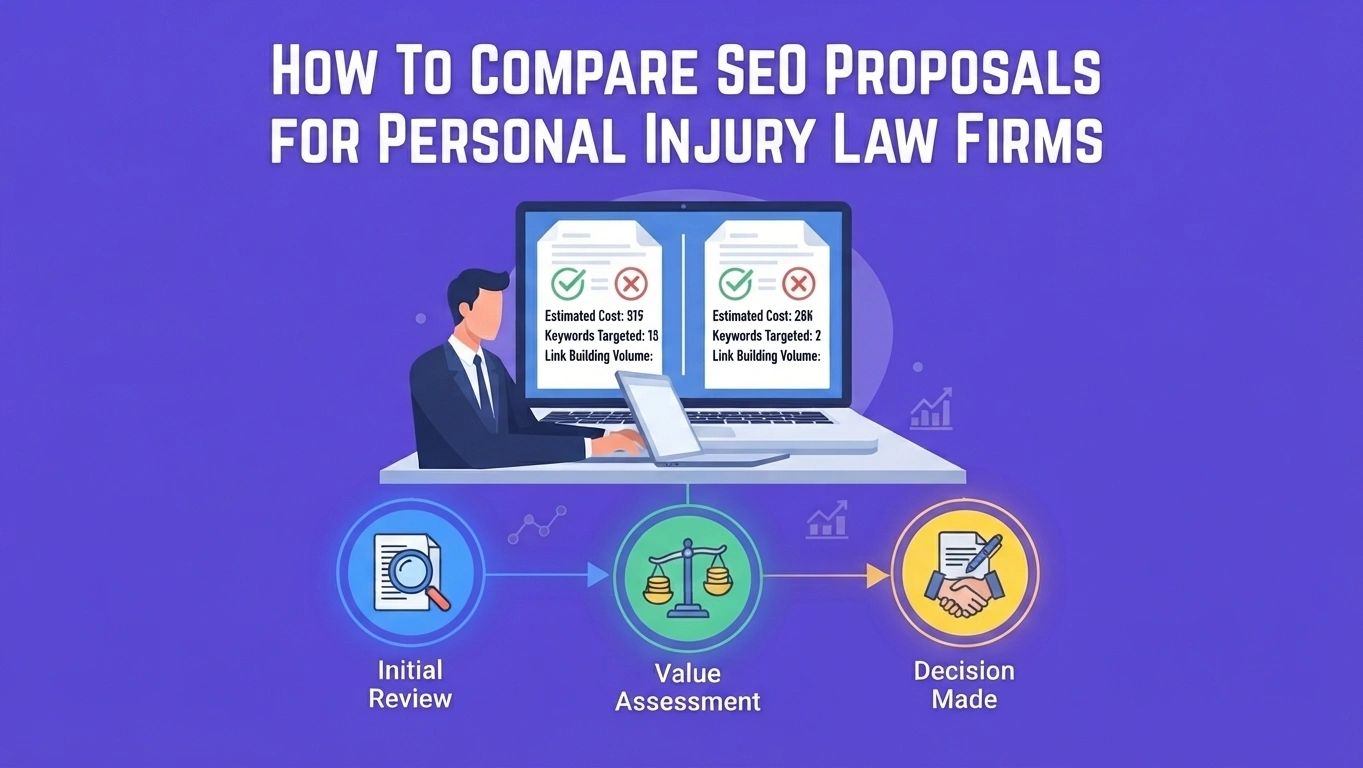
Start by placing each proposal into the same categories: business goals, audit, strategy, monthly deliverables, content, local SEO, technical work, link acquisition, reporting, ownership, contract terms, and total cost.
Determine whether each agency understands the firm’s target cases, service areas, competitors, and intake process. Look for specific deliverables instead of broad promises about “more traffic” or “top rankings.”
Confirm whether the fee includes implementation, content review, development work, tracking tools, and reporting. The proposal should also explain how qualified inquiries, consultations, and signed cases will be measured alongside rankings and traffic.
Effective SEO for personal injury lawyers cannot guarantee first-place rankings or a fixed number of cases. A strong proposal should connect realistic work, transparent methods, and measurable outcomes with the firm’s actual growth priorities.
Start With the Law Firm’s Business Goals
A proposal cannot be properly evaluated until the law firm defines what it wants the campaign to achieve.
The firm should identify its priority practice areas, geographic markets, preferred case types, and intake capacity. A firm focused on serious truck accident cases may need a different strategy from one seeking a broader mix of motor vehicle, premises liability, and wrongful death inquiries.
It is also important to define a qualified lead. Location, accident type, injury severity, timing, potential liability, and jurisdiction may all affect whether an inquiry is suitable.
An SEO agency should ask about these details before presenting a final strategy. If its recommendations show little understanding of the firm, market, or prospective clients, the proposal may be based on a generic template.
Make Sure Every Proposal Uses the Same Baseline
SEO agencies may evaluate websites using different tools and scoring systems. One report may emphasize technical problems, while another focuses on keywords or backlinks.
Each proposal should identify the website being evaluated, practice areas, target locations, and main competitors. It should also explain the current condition of the firm’s organic visibility, local presence, content, technical setup, and conversion tracking.
Automated audit scores can identify possible issues, but they are not a complete strategy. A useful audit should explain which problems matter, how they affect users or search visibility, and what should be fixed first.
Compare the Strategy, Not Just the Service List
Many proposals use the same phrases: keyword research, content marketing, technical SEO, local SEO, link building, and monthly reporting. These labels mean little without explanation.
The proposal should show how the services work together. Keyword research should inform practice-area and educational content. Technical work should help search engines access those pages. Local SEO should support legitimate locations, while conversion improvements should help appropriate visitors make contact.
Prioritization matters too. A site with major indexing problems may need technical corrections before publishing more content, while a technically sound site with weak service pages may need content improvements first.
The proposal should explain what happens first and why.
Compare Monthly SEO Deliverables
The phrase “ongoing SEO” is too vague. A proposal should explain what the law firm will actually receive.
| Proposal area | Questions to ask |
| Initial audit | Is it customized, and does it include priorities? |
| Content | How many pages or articles are included, and who reviews them? |
| Technical SEO | Are fixes implemented or only recommended? |
| Local SEO | Are profile updates, listings, reviews, and location pages included? |
| Link acquisition | How are links earned, evaluated, and reported? |
| Conversion work | Are calls, forms, and page performance reviewed? |
| Reporting | Are qualified leads and consultations included? |
| Communication | Who manages the account, and how often will meetings occur? |
The firm should also ask whether the agency can adjust the monthly plan when priorities change. A rigid content quota may not make sense if the website suddenly needs major technical work.
Evaluate the Proposed Content Strategy
Content is especially important because prospective clients often begin with questions about insurance, medical documentation, fees, filing deadlines, or the claims process.
A proposal should explain how topics are selected and connected to the firm’s services. It should address both new content and improvements to existing pages. Rewriting a weak practice-area page may be more valuable than adding another generic blog post.
Ask who will research, write, edit, legally review, approve, and publish the content. Attorneys or qualified legal reviewers should verify legal explanations, jurisdiction-specific details, and claims about the firm.
High content volume is not automatically a benefit. Original insight, legal accuracy, and relevance matter more than simply publishing as many articles as possible.
Examine the Local SEO Scope
Personal injury law is closely connected to location. A proposal should explain whether it includes Google Business Profile optimization, business-information consistency, trusted local listings, review guidance, and useful location pages.
It should also distinguish between legitimate offices and broader service areas.
Avoid proposals recommending fake offices, rented addresses used only for rankings, or keyword-stuffed business names. These tactics can create compliance, visibility, and reputational problems.
Understand the Technical SEO Work
Technical SEO proposals often contain terms that sound impressive but remain unclear to non-specialists. The agency should be able to explain each recommendation in plain language.
The scope may include crawling, indexing, redirects, duplicate pages, site architecture, internal linking, structured data, mobile usability, and page performance.
The proposal should clearly state whether the agency will implement fixes or only recommend them. If outside development is required, determine whether that work is included in the fee.
The firm should also retain visibility into major changes made to its website.
Investigate Link-Building Methods
Links from other websites can help search engines discover content and understand its broader reputation, but they can also create risk when acquired through manipulative methods.
Ask where links may come from, how websites are evaluated, and whether placement fees are involved. Legitimate strategies may include digital PR, legal resources, local organizations, professional relationships, or content that naturally earns references.
Be cautious of packages promising a fixed number of “high-authority” links without explaining relevance or acquisition methods.
The agency should report acquired links transparently and disclose associated costs.
Compare Reporting and Success Metrics
Rankings can show changes in visibility, but they do not reveal whether a campaign is producing suitable cases.
A proposal should explain how calls, contact forms, Google Business Profile actions, consultations, and qualified leads will be tracked. It should also identify which platforms will be used and whether the firm will have direct access.
The intake team should participate in measurement because marketing software can record a call, but intake staff determines whether the caller had a relevant legal matter.
A useful SEO campaign should connect search data with business results. Cost per qualified lead, consultation rates, and signed-case attribution may provide more insight than traffic growth alone.
Review Timelines and Forecasts Carefully
A proposal should include an implementation schedule, but that is different from guaranteeing an outcome.
An agency can estimate when it will complete audits, technical fixes, content, local profile work, and conversion tracking. It cannot know exactly when Google will change rankings or when a prospective client will sign.
Google’s guidance for hiring an SEO recommends seeking realistic estimates and warns that no one can guarantee a number-one ranking.
Forecasts should clearly explain their assumptions and dependencies.
Calculate the Full Cost of the Proposal
Monthly retainers are not always directly comparable. One fee may include content, technical implementation, reporting, and strategy calls, while another charges separately for those services.
Ask about setup fees, software subscriptions, call tracking, content, development, link-placement costs, and optional services.
Calculate the expected cost over the full commitment rather than comparing only the first month. A lower retainer may become more expensive if the firm needs to hire additional writers, developers, or analytics specialists.
The goal is not simply to choose the cheapest proposal. It is to understand what the firm receives for its investment.
Confirm Ownership and Account Access
The law firm should know who owns every important campaign asset.
This includes the website, domain, content, designs, Google Business Profile, Search Console, analytics accounts, advertising accounts, call-tracking numbers, dashboards, and login credentials.
The firm should retain appropriate administrative access. If the relationship ends, its content, historical data, and important account assets should remain available.
Ownership and transfer terms should be clearly stated in the proposal or contract.
Read the Contract and Exit Terms
A proposal explains the planned work, while the contract establishes the legal relationship. Both should be reviewed together.
Check the contract length, renewal structure, cancellation notice, termination fees, payment schedule, and refund policy. Determine what happens to unfinished work, scheduled content, and prepaid services.
Exclusivity provisions also deserve attention. The firm should understand whether the agency can work with direct competitors in the same market.
Unclear or significant terms may warrant review by the firm’s own attorney before signing.
Check Ethical and Legal Marketing Safeguards
Personal injury marketing may involve attorney advertising rules, testimonials, case results, fee claims, reviews, and confidential information.
The firm should retain final approval over legal content and claims about its attorneys or results. Testimonials should be genuine, and review responses should not disclose sensitive information.
The Federal Trade Commission’s advertising guidance states that marketing claims must be truthful, evidence-based, and neither deceptive nor unfair. Law firms must also follow applicable professional conduct and advertising rules.
An SEO agency can support the process, but the law firm remains responsible for approving its marketing.
Watch for Warning Signs in SEO Proposals
Common warning signs include:
- Guaranteed first-place rankings
- Claims of a special relationship with Google
- Secret methods that cannot be explained
- Vague monthly deliverables
- Large volumes of generic legal content
- Fake office, testimonial, or review strategies
- Manipulative link schemes
- No clear ownership terms
- Reporting based only on rankings and traffic
- Long contracts with unclear cancellation provisions
One red flag does not always prove a provider is unsuitable, but it should lead to more questions before signing.
What Questions Should You Ask an SEO Agency?
Ask who will manage the account, who will produce the content, and how often the firm will receive updates. Request examples of relevant work and references that can speak to communication and reliability.
The agency should be able to explain its experience with competitive local markets, legal content, and qualified-lead tracking. It should also describe what happens when a campaign is not meeting expectations.
Pay attention to the questions the agency asks in return. A provider showing no interest in the firm’s cases, locations, competitors, intake process, or business goals may struggle to develop a useful strategy.
Why Choose Click Typhoon for Personal Injury SEO?
Click Typhoon offers SEO services designed for personal injury law firms. Its approach includes local optimization, practice-area content, technical improvements, conversion optimization, and performance tracking.
These areas should work together within a clear strategy. Local visibility should support legitimate service areas, content should address relevant cases and client questions, technical work should improve website performance, and tracking should show whether visitors become appropriate inquiries.
Click Typhoon also emphasizes data-driven decisions, transparency, communication, and return on investment.
Firms can review Click Typhoon’s SEO services for personal injury lawyers and request a free SEO audit before deciding whether the approach fits their needs.
Frequently Asked Questions
What should a personal injury SEO proposal include?
It should include goals, an initial assessment, strategy, deliverables, responsibilities, timelines, reporting methods, ownership terms, contract conditions, and total costs. It should also explain how qualified leads will be measured.
How much should a personal injury law firm spend on SEO?
There is no universal amount. Appropriate spending depends on the market, competition, target locations, website condition, practice areas, required content, and growth goals. Firms should compare the full scope and total cost rather than monthly retainers alone.
How long should an SEO contract last?
Contract lengths vary. The important factors are whether the term matches the proposed work, renewal conditions are clear, and the cancellation process is reasonable.
Should an SEO agency guarantee rankings?
No. An agency can commit to defined work and an agreed strategy, but it cannot control Google’s rankings. Guaranteed first-place placement is a major warning sign.
Who should own the website content and analytics accounts?
The contract should state ownership clearly. In most arrangements, the law firm should retain ownership or continuing access to its website, approved content, profiles, analytics data, and other essential business assets.
What SEO results should a personal injury firm track?
Useful measures include organic visibility, local actions, qualified calls, contact forms, consultations, signed cases, conversion rates, and cost per qualified lead. Rankings and traffic should provide context rather than serve as the only measures.
Should an attorney review SEO content before publication?
Yes. An attorney or qualified legal reviewer should verify legal information, jurisdiction-specific statements, advertising claims, case results, and descriptions of the firm before publication.
Choose Clarity and Accountability Before You Sign
The best-looking proposal is not always the most useful. Personal injury law firms should compare how clearly each provider explains its strategy, deliverables, methods, costs, ownership, reporting, and contract terms.
A strong proposal connects SEO activity with the firm’s actual priorities and explains how the work may improve visibility while measuring whether that visibility produces qualified inquiries.
Take time to ask questions, verify important claims, and understand the commitment. If your firm wants an informed starting point, contact Click Typhoon to request a free SEO audit and discuss a strategy built around relevant searches and qualified leads.
Follow us on our socials here:
Check out some of our blogs to help with your SEO needs: